













































































Professional Propagation
0 products
Commercial propagation is judged on throughput and uniformity
Propagation is the stage that sets the consistency of every cycle that follows. Commercial propagation equipment is not sized on the number of trays available, but on the flow to be held each week: one batch coming in, one batch rooting, one batch going out, without ever mixing the three.
The tray, the unit of account in production
A grower does not think in cuttings but in trays: trays per tier, per trolley, per square metre of floor, and trays leaving each week. This unit governs both area sizing and internal logistics. The first question to put to a supplier therefore concerns compatibility with the tray format already in use: a structure that forces a change of tray also forces a change of plugs, of seeder and of working habits.
Rooting: microclimate and bottom heat
An unrooted cutting cannot regulate its water loss. Rooting calls for high humidity, a low vapour pressure deficit and no draughts, which explains the use of enclosed structures, dome or cover, rather than an open frame standing in a ventilated room.
The second lever is more often overlooked: substrate temperature governs rooting more than air temperature does. A room at the right temperature, with trays sitting on a cold metal frame, gives mediocre and irregular results. Bottom heat, by mat or by circulating water, is sized as an item in its own right, and its absence should be known before purchase.
Hygiene, ergonomics, traceability
Propagation is the stage where contamination spreads fastest: high density, permanent humidity, closely spaced handling. Three requirements follow.
- Washability: materials that resist disinfectants, no water traps, structures that come apart. Equipment that cannot be cleaned between batches becomes a reservoir of inoculum.
- Ergonomics: working height, access to the tray at the back, door and aisle clearance, and the ability to move a whole batch in one movement rather than tray by tray.
- Traceability: identification by tray or by trolley, entry date, origin of the plant material. This is what makes it possible, when something goes wrong, to isolate a batch instead of shutting down a room.
What this section covers
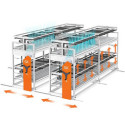
Propagation infrastructure falls here into two equipped groups and one separate branch. Tray-carrying structures and their microclimate covers belong to propagation racks and trolleys; work surfaces and containment trays belong to professional growing tables. Propagation under aseptic conditions is a separate discipline, dealt with separately. Complete configurations, including lighting and control, are studied project by project and priced on a quotation.
For non-professional use, the sowing, cuttings and germination section answers an entirely different scale. The blog sets out the step-by-step method for vigorous cuttings.