







































































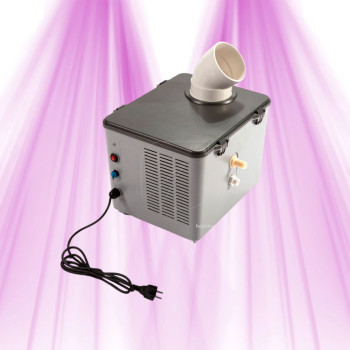
Ocean Mist Ultrasonic Humidifier Small Model - Varios - Fine Mist for…
Ships within 2 weeks
635,72 € or 3× 211,91 €

Product successfully added to your shopping cart
Ça pousse dans le bon sens

1 product
Dehumidification, humidification and cooling are sized together, from a water load expressed in litres per day and a heat load expressed in kilowatts. Never from a floor area.
A crop returns through transpiration almost all of what irrigation supplies: 1 to 5 litres per square metre per day depending on species, growth stage and the radiation received. It is that quantity of water to be removed from the air each day that determines the capacity to install, not a covered area printed on a data sheet. On an existing installation, an irrigation reading and a drainage reading are enough to establish it.
On the heat side, almost all the electrical power installed in lighting reappears as heat in the room, to which motors, people and, under glass, solar gains are added. The two balances are not independent:
A control system that drives these items separately makes them cancel each other out. Humidification and dehumidification must be interlocked against one another, with a sufficient dead band, and setpoints are better expressed as vapour pressure deficit than as relative humidity alone.
The only appliance attached to this level in its own right is a 7 L/h ultrasonic humidifier with replaceable ceramic membranes. An ultrasonic mister atomises water with everything it contains: limescale, dissolved salts, micro-organisms. Reverse osmosis water is not a refinement here but a condition of operation — without it, white deposit on foliage and scaled-up membranes. Tank maintenance is a hygiene matter: aerosolising stagnant water in an occupied room creates a health risk.
The equipment actually available in this branch is in industrial dehumidification. Air exchange, the third lever of climate, is calculated with our technical team from the installed lighting power and the temperature rise accepted. For non-professional use, the climate management section covers everyday needs. This section forms part of our professional range.


