



































































Water master
Water Master Spray Gun – Precision Watering for Indoor LED Growing
In stock · Shipped within 24 h
38,40 €

Product successfully added to your shopping cart
Ça pousse dans le bon sens

4 products
Spraying is not just about "getting the leaves wet". In an indoor grow, it is the one gesture that lets you feed your plants through their foliage, treat pests before they take hold, keep humidity up around cuttings and maintain clean leaves able to absorb every photon your LEDs produce. Provided you use the right sprayer, at the right moment.
Under LED lighting, your plants live in a closed environment where nothing happens by itself: no rain, no morning dew, no beneficial insects. Spraying replaces what nature would take care of outdoors. It serves four very concrete purposes.
The underside of a leaf is covered in stomata that absorb a diluted nutrient solution directly. It is the fastest way to correct a visible iron, magnesium or calcium deficiency: where a root-level correction takes five to ten days to show, a foliar feed often acts within 48 to 72 hours. Always work heavily diluted, between a quarter and half of the root dose, so you don't burn the leaf tissue.
Spider mites, thrips, aphids, powdery mildew: indoors an infestation explodes within days because no natural predator keeps the population in check. Neem oil, insecticidal soap, wettable sulphur, Bacillus thuringiensis — all of these are applied with a sprayer, and above all under the leaves, where pests hide and lay their eggs. A preventive spray every one to two weeks during veg costs far less than an emergency treatment mid-flower.
A cutting has no roots yet: it survives purely on the water it absorbs through its leaves. A light mist morning and evening, inside a propagator held at 70-80 % relative humidity, is the difference between successful rooting and a clone that wilts on day three. The same logic applies to freshly germinated seedlings.
Dust, salt residue and limescale build a film that reduces photosynthesis. A plain water rinse with the lights off gives the plant back all the PPFD you are paying for in electricity. It is also the perfect moment to spot the first spider mite webbing under the leaves.
Never with the lights on. This is rule number one. Every droplet sitting on a leaf acts like a magnifying lens focusing the beam: the result is pinpoint necrotic spots, often mistaken for a nutrient deficiency. Spray right after the LEDs switch off, or 15 to 30 minutes before, so the foliage dries in the dark.
Get your solution right. Aim for a pH between 6.0 and 6.5 and water at room temperature, 18 to 22 °C. Water that is too cold shocks the leaf tissue; water that is too hard leaves a white film. Always filter your mix before filling the tank — suspended particles are what clog nozzles.
Target the underside of the leaves. That is where the stomata are, and where the pests live. A sprayer with an adjustable nozzle or a swivelling lance lets you reach under the canopy without snapping branches.
Stop during full flower. Past the second or third week of flowering, stop spraying the flowers entirely. Moisture trapped between the bracts opens the door to botrytis, the grey mould that can ruin a harvest in 72 hours. If a treatment is genuinely needed, apply it during veg or at the very start of flowering.
Ventilate afterwards. Keep the air moving. Foliage that stays wet for more than an hour or two becomes a playground for fungi. A fine mist dries far faster than a coarse jet that runs off into the substrate.
The right model mostly depends on the area you treat and how long your sessions last.
Up to four or five plants, occasional use. A trigger sprayer is enough. The Ribimex 1 Litre Trigger Sprayer is the classic backup unit: light, translucent body so you can check the level, ideal for a cutting, a spot treatment or a quick foliar feed.
For longer sessions. As soon as you treat a full tent, a trigger tires your hand. The 1.3 L Piston Sprayer is pressurised with a few pump strokes and then delivers a steady spray with no effort. Its constant pressure keeps droplet size consistent, exactly what a uniform foliar treatment requires.
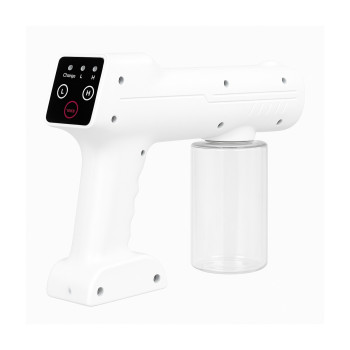
For precision watering. The Water Master Spray Gun plays a different role: an adjustable jet from fine mist to a solid stream, to water at the base without digging into the substrate, moisten a rockwool block or reach a specific part of the canopy. It is the everyday tool of an LED grow space.
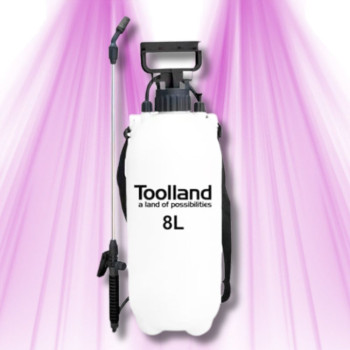
For large areas. Beyond a single tent, across several square metres, in a greenhouse or outdoors, you need autonomy. The TOOLLAND 8 Litre Pre-Pressure Sprayer is pumped once, carried on a shoulder strap, and its adjustable lance lets you treat continuously without refilling every five minutes.
Rinse the tank, lance and nozzle with clean water after every use, then run half a litre of fresh water through the circuit to purge any residue. Above all, never mix purposes: keep one sprayer for foliar feeds and another for treatments. A trace of insecticide or herbicide in a tank meant to carry nutrients can damage an entire crop. It is the most common and most expensive mistake, and a simple marker pen label on the tank prevents it.
No. Droplets act as lenses and focus light onto a single point of the leaf, causing pinpoint burns that are frequently mistaken for a deficiency. Always spray with the lights off, or 15 to 30 minutes before lights-out so the leaves finish drying in the dark. The risk applies to any powerful light source, LED or HPS alike.
Preventively, once a week to once every two weeks throughout the vegetative stage. Curatively against spider mites or thrips, plan three passes five to seven days apart to break the egg-laying cycle. For cuttings, a light mist morning and evening until roots appear. In late flower, stop completely.
For an 80×80 or 100×100 cm tent, 1 to 1.5 litres is plenty: you cover everything without refilling. For a 120×120 or several tents, a 2 to 5 litre model saves the back and forth. Beyond that, in a grow room, greenhouse or outdoors, go straight to 8 litres with a carrying strap.
A trigger sprayer atomises on each squeeze: simple and immediate, but tiring after a few minutes and with pressure that varies from one squeeze to the next. A pre-pressure model is pumped up first, then delivers a continuous, even spray for as long as pressure remains in the tank. To cover a lot of foliage evenly, pre-pressure wins every time.
It is not recommended. Residues of neem oil, soap or pesticide cling to the walls and seals even after rinsing, and can react with your nutrient solution or stress the plants. Two clearly labelled sprayers cost about the price of a meal and save you from losing a crop.
The underside first. That is where the stomata are concentrated, so where foliar nutrients are absorbed, and where pests live and breed. A pass over the top completes the job, but targeting only the upper surface lets the infestation bounce back within days.