









































































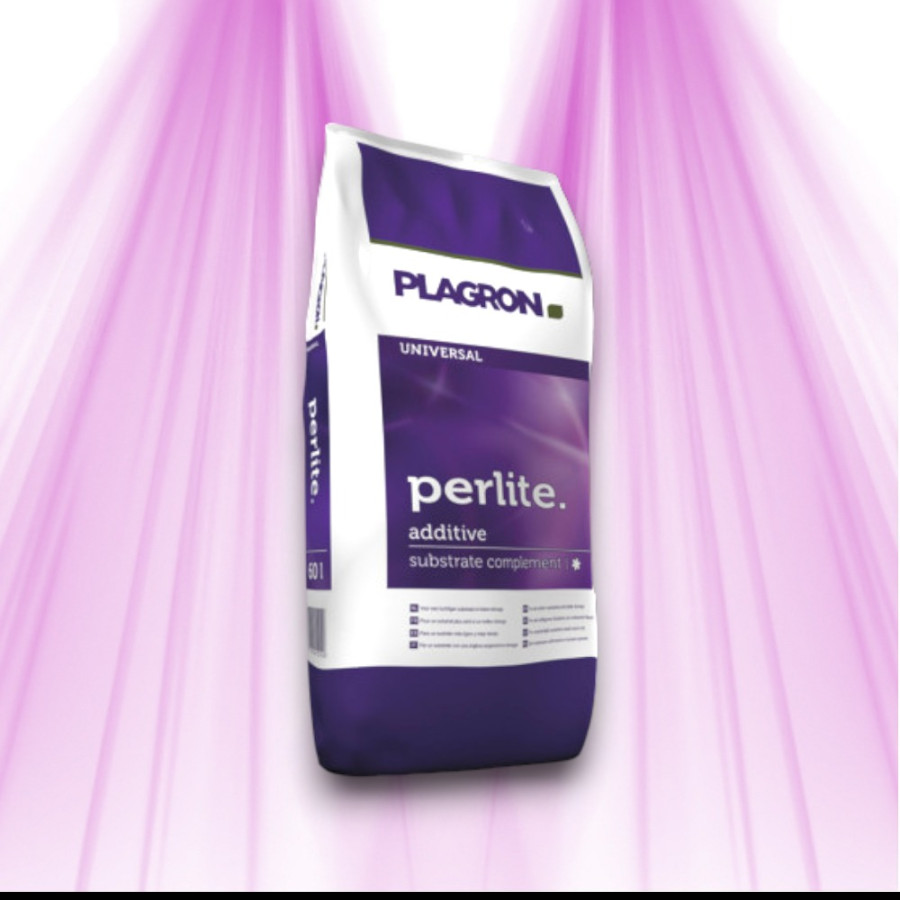


Plagron Perlite 60L – soil amendment for aeration and drainage
60 litres RHP, Conforme UE 2019/1009 All substrates
- Light and Expanded Perlite
- Improves Root Growth
- Compatible with All Hydroponic Systems
- Reduces the Risk of Oversupply of Water
- Ideal for Germination Projects
Satisfait ou remboursé
14 jours
Retour 14 jours
Frais de retour à votre charge
SAV expert FR
Conseil horticole
Paiement en plusieurs fois
with Alma, from €50 — or pay in 15 days from €100
Plagron Perlite 60L – soil amendment...
47,90 €
Parraine tes proches
5 % pour toi & 5 % pour ton ami
Description
Product presentation
Discover the power of Perlite Plagron , a horticultural rock that redefines soil aeration and hydroponic substrates. With its unique properties, this 60 liter bag of Perlite is the key to unlocking optimal plant growth.
Key Features:
Volcanic Excellence: Plagron Perlite is extracted from volcanic rock, expanded to perfection, ensuring superior aeration for dense soil mixtures.
Hydroponic Advantage: Ideal for germination and cultivation in capillary or percolation irrigation systems, ensuring consistent humidity levels for your plants.
Oxygen Boost: Increases oxygen content in substrates, promoting robust root development and overall plant health.
Drainage Control: Improves pot drainage, avoiding waterlogged soil and reducing the risk of root diseases.
Long-lasting Results: Delays soil compaction, providing a sustainable environment for your plants to flourish.
Opinion from an Expert Grower:
"A real game changer for my garden! Plagron Perlite has dramatically improved soil aeration, promoting healthier plants. The increase in oxygen is noticeable, and the improved drainage has kept my plants stress free linked to water. A must-have for any serious grower."
Questions/Answers section:
Q: How does Plagron Perlite improve oxygen levels in the substrate?
A: The lightweight structure of Plagron Perlite increases oxygen availability in the root zone, promoting vigorous plant growth.
Q: Can I use Plagron Perlite for hydroponic systems?
A: Absolutely! Plagron Perlite is perfect for hydroponic setups, ensuring optimal humidity levels for your plants.
Q: Is a 60 liter bag enough for a standard gardening project?
A: Yes, the 60 liter bag offers a generous amount of Perlite for various applications, from soil mixes to hydroponic systems.
Elevate your growing game with Plagron Perlite - the choice for healthier plants and bountiful harvests.
Technical data sheet
Features detailed
| Packaging | 60 litres |
|---|---|
| Certification | RHP, Conforme UE 2019/1009 |
| Growing medium compatibility | All substrates |
| Type | Perlite |
| Weight (kg) | 9-11 |
| Recommended dosage | 10 à 35% du substrat |
| Maximum EC (mS/cm) | 0.0-0.1 mS/cm |
| Recommended pH in hydroponics/coco | 6.0-8.0 |
| Rinse before use | Oui |
| Reusable | Oui |
| Medium type | Perlite |
| Volume (L) | 60 |
| Particle size distribution | 0-6mm (souvent 3-4mm) |
Convinced? Shipped from France. Add to cart — 47,90 €
They've adopted it
Reviews customers
Soyez le premier à donner votre avis !
Partagez votre expérience avec ce produit.
Frequently asked questions
Your questions
Is Plagron Perlite compatible without any problem with other types of growing substrates?
Absolutely, Plagron Perlite 60L is designed to be mixed with all types of growing substrates. Whether it's potting soil, coco, or even growing systems like hydroponics, its use is aimed at optimizing soil drainage and aeration. Perfect compatibility, therefore, contributing to the good development of your crops.
For a 30/70 soil and perlite mix in indoor cultivation under 600W LED, what precise impact will this have on humidity management and root development?
A Plagron 30/70 soil/perlite mix under 600W LED will provide excellent drainage due to the high proportion of perlite, thus limiting the risk of excess water and root diseases. The perlite will also improve substrate aeration, promoting a healthy and vigorous root system. This mix offers sufficient water retention while maintaining a well-oxygenated root environment, ideal for optimal root development.
Can one mix Plagron Perlite with other substrates without risking loss of aeration or effective drainage?
Yes, it is indeed possible to mix Plagron Perlite 60L with other substrates without compromising aeration or drainage. Perlite improves soil structure by providing lightness and porosity, which promotes a good air/water balance. It is generally recommended to incorporate it at a rate of 10% to 35% depending on the desired mix. Its consistent quality and ability to remain stable in the substrate make it an excellent ally for optimizing root growth and overall plant health.
Can Plagron Perlite 60L be reused after hydroponic cultivation without losing effectiveness in aeration and drainage?
The Plagron Perlite 60L can definitely be reused after a hydroponic cultivation, provided that it is thoroughly rinsed to eliminate any contamination. This cleaning is essential to maintain its aeration and drainage qualities. Well-maintained and checked for the absence of pathogens, it retains optimal efficiency due to its high durability.
Just make sure it is clean and dry before using it again.
Just make sure it is clean and dry before using it again.
Does Plagron Perlite maintain its integrity and aeration and drainage capabilities over the months with repetitive use, or does it end up compacting and losing its effectiveness?
The Plagron Perlite 60L perfectly maintains its integrity and aeration and drainage capabilities even with repetitive use. Thanks to its lightweight and porous structure, it does not compact easily and maintains excellent aeration of the substrate over the long term. This guarantees an optimal environment for the roots, avoiding compaction and promoting sustainable root development.
Using 60L of Plagron Perlite, what percentage do you recommend to optimize aeration and drainage in a small soil mix?
To optimize aeration and drainage with 60L of Plagron Perlite on a small area, it is recommended to incorporate between 10 and 35% of the total volume of your soil mix. For example, if you have 120L of soil, use approximately 12 to 42L of perlite, adjusting based on the type of plant and substrate.
This percentage improves soil structure, facilitates drainage, and promotes healthy rooting. Remember to thoroughly mix the perlite with the soil for an even distribution, and wear a dust mask during the operation.
Is Plagron Perlite 60L compatible with small pot cultures like 20x20 or 30x30 to optimize aeration without the risk of rapid substrate drying?
The Plagron Perlite 60L is perfectly suitable for small pot cultures of 20x20 or 30x30 cm. With its grain size of 3-4 mm, it effectively improves aeration and drainage of the substrate without causing rapid drying.
By incorporating it at about 10-15% into a potting soil, you optimize root oxygenation while maintaining good water retention, which is ideal for reduced volume cultures where water balance is essential. This mix promotes healthy and vigorous growth of plants in small containers.
Is it possible to integrate Perlite Plagron into an automated indoor growing system with humidity and temperature monitoring to adjust watering in real time?
Yes, Perlite Plagron 60L integrates perfectly into an automated indoor growing system with humidity and temperature monitoring. Its lightweight and porous structure ensures excellent drainage and optimal aeration, allowing humidity sensors to provide accurate readings. This facilitates real-time adjustment of watering, avoiding overwatering or water stress for your plants.
For best results, it is advisable to mix it with another substrate (soil, coconut fiber...) to optimize water retention while benefiting from its aerating properties. Its responsiveness to humidity variations makes it an ideal choice for effectively controlling your automated irrigation cycles.
What are the right dosages to mix Plagron Perlite with potting soil without compromising water retention capacity?
To mix Plagron Perlite 60L with your potting soil while maintaining good water retention capacity, it is advisable to incorporate between 10% and 35% of perlite. A dosage around 20% to 25% is an excellent compromise to improve aeration and drainage of the substrate without overly reducing its ability to retain moisture. Perlite thus promotes root oxygenation while maintaining a neutral pH of the potting soil.
Can we automate the management of humidity and drainage in a substrate mixed with Plagron Perlite through connected sensors to optimize growth in indoor cultivation?
The Plagron Perlite 60L is perfectly suited for automated management of humidity and drainage in indoor cultivation. Its porous structure ensures excellent oxygen supply to the roots while having a partial water retention capacity, preventing stagnation and water stress.
Integrated into a substrate, it facilitates the use of connected sensors that continuously measure soil moisture. These sensors can control automated irrigation systems to precisely adjust watering, which optimizes root development and the overall health of the plants.
This substrate is therefore an excellent choice to accompany modern and connected systems, where fine regulation of water is essential.
What proportion of Plagron perlite do you recommend incorporating into the potting soil to optimize aeration without compromising the essential nutrients for plants in mixed soil and hydroponic cultivation?
To optimize aeration without compromising nutrients during mixed soil/hydroponic cultivation, it is advisable to incorporate between 10% and 15% of Plagron perlite into the total volume of the potting soil. This proportion fosters an excellent balance between oxygen and water, thus stimulating root development while preserving essential nutrients.
What proportion of perlite Plagron do you recommend in a classic soil mix to optimize both aeration and water retention without disrupting root nutrition?
To optimize aeration and water retention without disrupting root nutrition, we recommend incorporating between 10% and 35% of Perlite Plagron 60L in your classic soil mix. This proportion ensures a good balance: a soil that is sufficiently draining and aerated while maintaining adequate hydration for the roots.
For delicate seedlings or young plants, a mix richer in perlite, up to 50%, can be considered, but this is not necessary for the majority of standard crops.
What proportion of Plagron Perlite do you recommend incorporating into a soil mix to optimize aeration and drainage without compromising water retention?
For an optimal balance between aeration, drainage, and water retention, it is advised to incorporate Plagron Perlite at a rate of 10 to 35% into your soil mix. This range helps promote root development while maintaining a substrate that is sufficiently moist, ideal for most indoor crops.
What is the exact grain size of Plagron perlite and its impact on moisture retention versus a traditional soil mix?
The grain size of Perlite Plagron 60L is precise, between 3 and 4 mm. This regular size ensures excellent aeration and effective drainage of the substrate.
Compared to a traditional soil mix, perlite retains water while avoiding excess moisture thanks to its porous structure. While a traditional soil mix can hold more water, it can also limit air circulation around the roots. Thus, perlite improves the substrate structure, perfectly balancing water retention and oxygenation, which promotes healthy rooting.
In practice, integrating between 10 and 35% of perlite into your soil significantly enhances root development by optimizing the water/air ratio in the substrate.
What quantity of Plagron perlite 60L should I use to optimize yield in a 1m² substrate in hydroponic culture with a percolation system?
To optimize the yield of a substrate in hydroponic culture with a percolation system over 1 m², it is advised to incorporate approximately 20 to 25% of Plagron 60L Perlite into the total volume of the substrate. Thus, for a substrate layer of about 10 cm thick (which is 100 liters), you will use between 20 and 25 liters of perlite. This dosage ensures a perfect balance between aeration, drainage, and moisture retention, promoting excellent root development and optimal yield.
What are the optimal mixtures to make with Plagron Perlite to grow several varieties at the same time in a single room?
To grow several varieties in the same room with Plagron Perlite 60L, it is ideal to create a mixture containing between 10% and 35% perlite in the main substrate (potting soil or growing mix). This proportion ensures excellent root aeration and efficient drainage while maintaining good water retention.
Be sure to mix the perlite well with a homogeneous and quality substrate. Adjust the amount according to the specific needs of the plants: around 30% for varieties that require more drainage, about 10-15% for those that prefer better moisture retention. Perlite, sterile and neutral, offers a light and stable structure suitable for mixed cultivation, promoting healthy growth even with slightly different needs.
Does Plagron perlite maintain its granulated structure for a long time without compacting, even after several cycles of intensive watering?
The Plagron perlite 60L perfectly retains its granulated structure over time, even after several cycles of intensive watering. Due to its nature as baked volcanic rock, it remains light and porous, ensuring excellent ventilation and optimal drainage. Its physical integrity is such that it does not compact easily, which guarantees a good balance between water retention and root aeration. It is a reliable choice for maintaining the quality of the substrate during indoor cultivation.
How to optimize the use of Plagron perlite in a substrate mix for several varieties with different needs for aeration and water retention?
To optimize the use of Plagron Perlite 60L in a substrate mix intended for several varieties with different needs, it is essential to adjust its proportion according to the requirements for aeration and water retention:
- 30 to 35% perlite for plants requiring maximum aeration and good drainage (light, well-aerated substrate).
- 10 to 15% perlite for those that require more water retention, in order to maintain a good balance between moisture and oxygen.
- About 20% in a versatile substrate for general use.
Perlite, thanks to its porous and sterile structure, improves soil structure by increasing oxygenation and drainage without compromising water retention capacity, promoting healthy and vigorous root development.
For a homogeneous mix, make sure to incorporate the perlite well to avoid overly compact or overly draining areas. Don't hesitate to prepare multiple substrates suited to each type of plant to make the most of this lightweight and effective material.
What is the difference in porosity and bulk density between Plagron perlite 60L and other types of standard perlite, and how does this impact the aeration/drainage ratio in a mixed soil + perlite substrate?
The Plagron perlite 60L has an average grain size of 3-4 mm, comparable to that of standard horticultural perlites. It is very lightweight, with a low bulk density and high porosity, typical of expanded perlites, ensuring an excellent balance between aeration and drainage.
Compared to classic perlites, which generally have a density ranging between 90 and 130 kg/m³, Plagron perlite, due to its certified quality and controlled grain size, optimizes the aeration/drainage ratio in a substrate mixing potting soil and perlite. This balance promotes better root oxygenation while avoiding waterlogging.
In practice, by incorporating 10 to 15% of Plagron perlite 60L into the soil, the substrate becomes lighter, better drained, and aerated, thus stimulating the health and root development of plants.
What is the ideal proportion of Plagron Perlite (as a percentage of total volume) to maximize aeration and drainage without compromising water retention in a mixed substrate?
To maximize aeration and drainage while maintaining good water retention in a mixed substrate with Plagron Perlite 60L, the ideal proportion is between 20 and 30% of the total volume. This dosage optimizes the balance between oxygen and water supply for the roots, ensuring a lightweight and well-structured substrate without compromising its moisture. Below 10%, the effect on drainage remains low, and beyond 35%, the water retention capacity can be reduced, which could lead to dehydration of the plants.
Is Plagron perlite suitable for a 3L micro pot in compact indoor cultivation to optimize drainage without overloading the substrate?
The Plagron perlite 60L is perfectly suited for a 3L micro pot in compact indoor cultivation. By mixing between 20% and 25% of perlite with your main substrate, you will optimize drainage and aeration of the roots without weighing down or drying out the mixture. Its lightweight and porous structure reduces the risk of waterlogging, promotes root growth, and maintains a neutral pH, ideal for a confined space. It is an excellent way to balance water retention and oxygenation in a small volume without compromising the health of your plants.
Not seeing your question?
Your browsing
Viewed recently


Related articles
 Boost your indoor crops with the secrets of Plagron fertilizers and their premium additives!
Discover the Plagron brand fertilizers and additives, available on our GrowLED site, for successful indoor growing....
Read more


